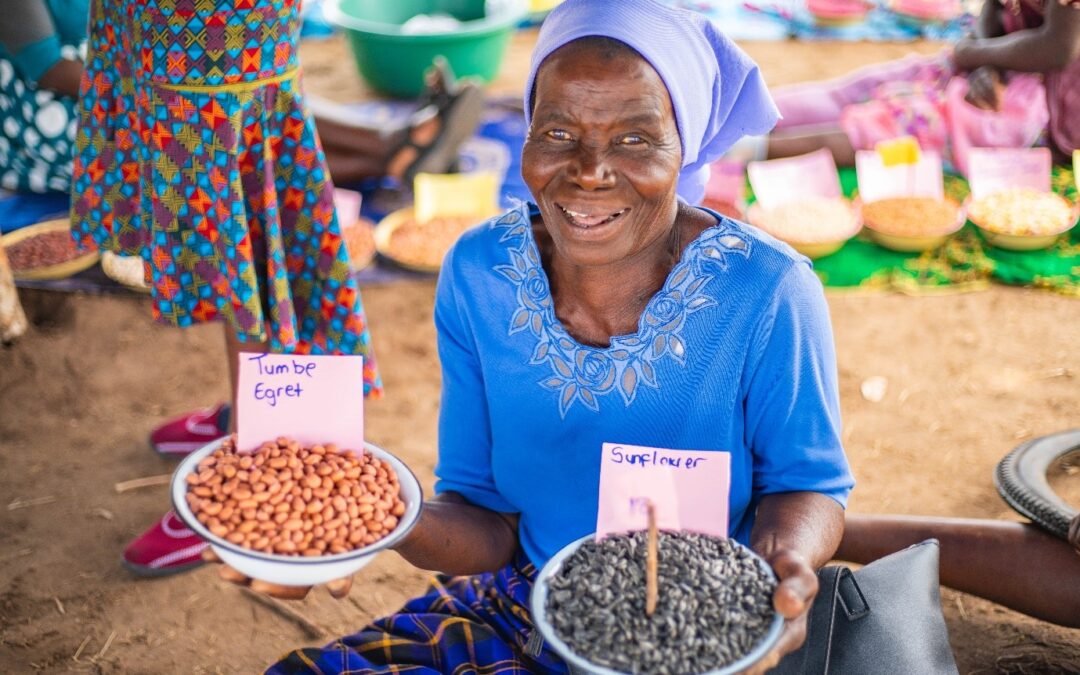
Picture © Kudzanai Chimhanda, Communications Specialist, CIMMYT
While restrictive seed laws threaten farmer-managed seed systems worldwide, several countries in the Agroecology Coalition are charting a different path – one that recognizes seeds as the foundation of resilient, agroecological food systems. From Tanzania’s groundbreaking National Ecological Organic Agriculture Strategy to Burkina Faso’s explicit inclusion of farmer seeds in national policy, these examples demonstrate that protecting farmers’ rights to seeds is not only possible but essential for food sovereignty and climate resilience.
Tanzania: A continental pioneer in agroecological seed policy
In 2023, Tanzania became one of the first countries worldwide to establish a national strategic pathway to agroecological transition with the adoption of its National Ecological Organic Agriculture Strategy (NEOAS) 2023-2030. For those working on seed sovereignty, this represents a watershed moment.
The NEOAS contains a dedicated chapter on seeds that explicitly recognizes the importance of supporting farmer-managed seed systems. This wasn’t accidental – it was the result of 20 years of advocacy by Tanzanian civil society, particularly two key networks: the Tanzania Organic Agriculture Movement (TOAM), uniting over 100 organizations, and the Tanzania Alliance for Biodiversity (TABIO), which brings together farmers’ organizations alongside national and international NGOs promoting farmers’ seeds.
Their success is particularly significant because Tanzania’s 2003 Seeds Act prohibits the exchange and sale of farmers’ seeds. The NEOAS signals government commitment to reforming these restrictive regulations. Rather than criminalizing the seed systems that feed most Tanzanians, the strategy acknowledges them as vital infrastructure requiring support and investment.
Tanzania is also building what may become Africa’s first comprehensive national seed bank system designed to serve agroecological farmers. Unlike conventional gene banks focused solely on preservation, this initiative aims to make diverse, locally adapted varieties accessible to farming communities while supporting the knowledge systems that sustain them.
Burkina Faso: Seeds at the heart of transformation
Burkina Faso’s Stratégie Nationale de Développement de l’Agroécologie (SND-AE) 2023-2027 explicitly includes “utilisation des semences paysannes” (use of farmer or peasant seeds) as part of its vision and impact goals. The strategy aims to support local seed systems to strengthen agrobiodiversity and resilience.
This explicit commitment challenges the deeply embedded paradigm that only professional breeders can breed quality seeds. Burkina Faso’s strategy recognizes farmers as breeders and seed producers in their own right, acknowledging that for 10,000 years, farmers created and maintained crop diversity.
Burkina Faso also learned hard lessons from promoting commercial agricultural technologies that didn’t serve farmers’ needs. The country discontinued Bt cotton production after discovering the lint quality was far inferior to local varieties, causing significant losses for Burkinabé cotton growers and merchants. This experience reinforced understanding that seeds cannot be separated from the agroecological and economic contexts in which they’re used.
Moving toward pluralistic seed systems
What unites these national approaches is movement toward pluralistic seed systems – not the elimination of formal seed systems, but creating space where farmers can choose whether to save their own seeds, buy seeds produced by other farmers, or purchase certified seeds. Each option has advantages and disadvantages, and farmers are best placed to make these decisions.
Currently, many states regulate seeds so strictly that they only allow formal, certified seeds, which means farmers don’t have genuine choice. Countries in the Agroecology Coalition are working to change this by creating proportionate, farmer-appropriate alternatives to expensive, bureaucratic certification processes designed for industrial monoculture.
This might include participatory guarantee systems (PGS) like those developed by Colombia’s Semillas de Identidad network, quality-declared seeds assessed by farmers themselves, or registration systems for farmers’ varieties like Nepal’s successful “landrace” model that allows collective ownership and legal sale of traditional varieties.
The work of Tanzania, Burkina Faso, and other Agroecology Coalition members demonstrates that national strategies supporting farmer-managed seed systems are both achievable and essential. They prove that recognizing farmers as legitimate seed producers and protecting their rights can happen at the highest levels of government. The question now is whether others will follow their lead, or whether international pressures toward privatization will continue undermining the seed systems that feed most of the world.
Find out more:
Tanzania:
Tanzania National Ecological Organic Agriculture Strategy (NEOAS) 2023-2030
3rd National Ecological Organic Agriculture Conference (NEOAC) Tanzania
Tanzania Building First Seed Bank in Africa
Burkina Faso:
Burkina Faso: L’agroécologie Transformationnelle – Groundswell International
Reports and Resources:
CAFOD Seed Systems and Gender Equality Report
SWISSAID Seeds at Risk: Global Struggles for Control over Food