
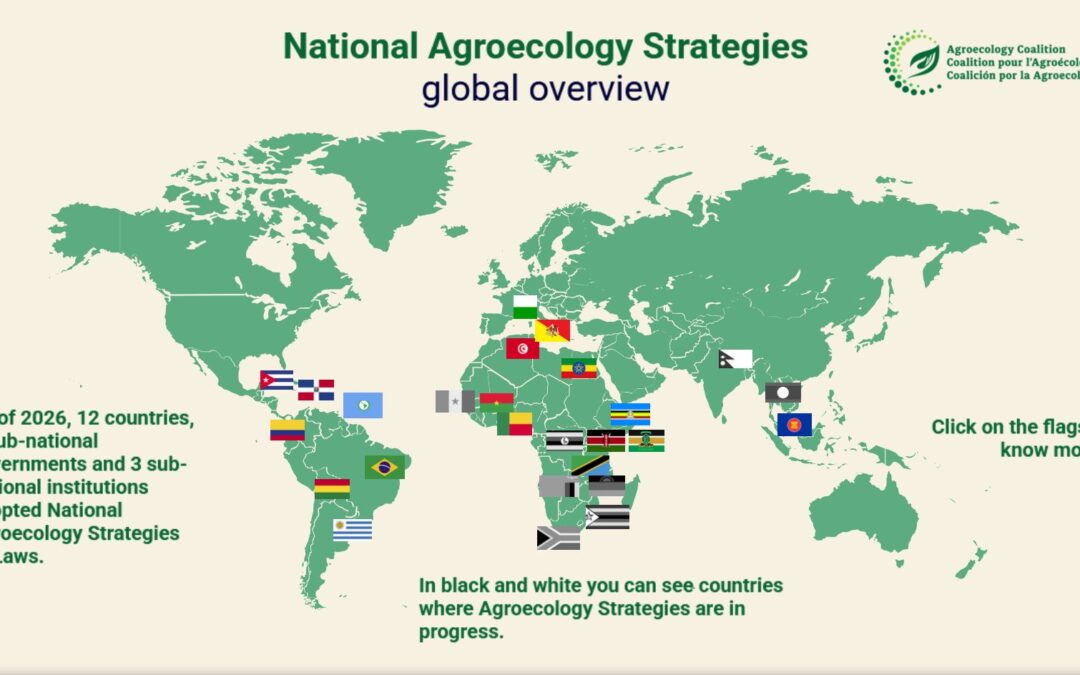
An overview of these policies is available on the Agroecology Coalition website here.
ROME, March 30, 2026- Plans by 12 governments – including globally important commodity exporters such as Brazil and Kenya – to adopt nature friendly farming practices to protect food supplies and agriculture exports from shocks such as the conflict in Iran are being launched by the Agroecology Coalition.
Half the world’s calories depend on synthetic nitrogen fertilizer made from gas – prices of which have spiked as a result of the conflict in the Middle East – while a quarter of the global fertilizer trade passes through a single 21-mile-wide chokepoint in the Strait of Herratz that is now effectively closed. Meanwhile, escalating climate impacts are costing agriculture an estimated 100 billion USD per year.
The Compendium, available here, details agroecology strategies, policies and laws adopted – or in the process of being adopted in Benin, Bolivia, Brazil, Burkina Faso, Colombia, Cuba, Dominican Republic, Ethiopia, Kenya, Tanzania, Tunisia, Uruguay, Sicily in Italy, Vaud in Switzerland, the Association of Southeast Asian Nations (ASEAN) and Parlatino (Latin America and Caribbean region) and the East Africa Community. It includes some of the world’s biggest exporters of coffee, sugar, tea, rice, vegetables, and olive oil.
“We are at the beginning of a major shift in the global food systems landscape. An increasing number of countries recognise the need to create a food system that can cope with market volatility and climate shocks to protect farmers and consumers. By reducing reliance on fossil fuel fertilisers and promoting crop diversity, agroecological farming offers a more sustainable and resilient approach to food production. – Oliver Oliveros, Agroecology Coalition Executive Coordinator.
Brazil is the first country to roll out a National Plan for Agroecology and Organic Production through initiatives such as the creation of “bio-factories” in rural communities to produce fertilizer from animal waste and crop residues, and promoting alternative technologies, such as locally adapted seeds and seedlings resistant to disease and pests.
Fernanda Machiaveli, Vice Minister for Agrarian Development and Family Farming of Brazil said: “Brazil’s strategy ensuring that technical knowledge reaches the communities and that traditional knowledge is valued. It also ensures that the State will buy agroecological and organic products, whether for school meals or for Brazil’s social assistance network.”
While Kenya’s strategy – adopted in 2024 – includes initiatives to reduce food loss and waste and boost urban food production such as reducing post-harvest losses through improved storage and handling, strengthening local and shorter food value chains, promoting food processing and preservation at community level.
A ten-fold increase in funding is needed to support the adoption of agroecological approaches. The UN estimates governments spend approximately $385 billion a year on subsidies for intensive agriculture which damages people’s health, fuels climate change, destroy nature and drives inequality by excluding smallholder farmers. Redirected, these subsidies will contribute significantly to the estimated $430 billion annual investment needed to maximize the social, economic, and ecological benefits of transitioning to agroecological food systems.
Agroecology works with nature to create a thriving farm ecosystem. For example, it uses natural fertilizers such as compost and nitrogen fixing plants to boost productivity and enhance climate resilience and encourages insects which act as natural predators to deter pests.
Notes to editors:
- The Agroecology Coalition was set up in 2021 up to provide a mechanism for countries and organizations to collaborate on food systems transformation through agroecology while addressing multiple crises simultaneously. Building on and amplifying the work of its members both from government and non-state actors, the Coalition facilitates co-creation and exchange of knowledge, fosters increased investments, advocates for supportive policies and promotes market pathways for agroecology.
- National agroecology strategy compendium available here
- 53 country briefs (one per government member of the Agroecology Coalition) – highlighting agriculture and food system related strategies, programmes and international commitments, but also how agroecology can be mainstreamed in those, available here
- Video on Financing the Agroecology Transition, with several international donors, available here.
- Media contact: Valentina Pavarotti, Agroecology Coalition Communications Officer, pavarotti@agroecology-coalition.org