
Nutrition in City Ecosystems (NICE)
Bangladesh
Led by Swiss TPH in partnership with ETH Zurich, Sight and Life Foundation, Sustainable Agriculture Foundation, and Enterprise for Society Centre (E4S), the project strengthens urban food systems by integrating inclusive food governance, agroecological production, healthy diets, and policy learning and scale-up. The project builds on multi-sectoral city platforms that bring together local governments, farmers, health and education actors, civil society and the private sector to coordinate nutrition and food-system action. Its Availability and Production activities support smallholder farmers, particularly women and youth, with agroecological training, diversified production, productive resources, post-harvest value addition and market access to increase the supply of affordable, safe and nutritious local foods. The Knowledge and Demand component promotes healthy diets, food safety and consumer demand for nutritious locally produced foods, while Policy, Learning and Scale-up generates evidence, facilitates cross-city learning and translates local experience into wider food and nutrition policies. Together, these interconnected outcomes strengthen resilient, inclusive and nutrition-sensitive urban–rural food systems in Bangladesh.
Lead organizations
Organizations involved in the project include the Swiss Tropical and Public Health Institute (Swiss TPH): based in Basel, Switzerland, is a world-leading institute in global health with a particular focus on low- and middle-income countries.
Other organizations involved include: The Enterprise for Society Center (E4S), which is a leading hub in Lausanne, founded by the University of Lausanne, and serving as a laboratory for rethinking economics and management. ETH Zurich, which is a public research university in the city of Zürich, Switzerland, working on agriculture, agroecology, and city region circular economy. Sight and Life (SAL): a member of the Network of Swiss Foundations, has expertise spanning the translation of nutrition science, building public-private partnerships, and the development of viable social business models. The Sustainable Agriculture Foundation (SAF): an independent, non-profit organization established by SAFIA based in Basel, Switzerland.
Country
The project is implemented in Bangladesh (Rangpur, Dinajpur), Kenya (Busia, Bungoma), Rwanda (Rubavu, Rusizi), with recent expansion in Senegal (Bambilor, Kaffrine) in January 2026.
Timeline
The project started in August 2021 and will run until December 2028. It is divided into two phases: Phase I from August to June 2025, then Phase II from July 2025 to December 2028.
Funding
The project had a total budget of EUR 27 million funded by Swiss Agency for Development and Cooperation (SDC), and co-financing from NICE partners mentioned above. EUR 10 million for Phase I and EUR 17 million for Phase II.
Context
Bangladesh’s food and agricultural system face intersecting demographic, climatic, ecological and public health pressures. With a population density of approximately 1,382 people per km², the delta country is highly exposed to flooding affecting 20–25% of its area, salinity across approximately 1.05 million hectares of coastal soil and 1% of agricultural land, heat-stress losses equivalent to 0.4% of GDP, and climate-related shocks affecting 11–17% of its land. Agricultural production simultaneously relies heavily on external inputs, with approximately 80% of fertilizer requirements dependent on imports and fertilizer use increasing by over 300%, alongside intensive groundwater extraction; in the Barind Tract, groundwater levels are declining by approximately 1 meter annually, while groundwater supports about 90% of irrigated agriculture. These pressures increasingly intersect with public health, with pesticide residues reported in over 29% of vegetables, pesticide-related exposure and health risks affecting 87–92% of farmers, and foodborne illnesses affecting an estimated 30 million people. Against this backdrop, Bangladesh is shifting its policy emphasis from food security alone towards nutrition security, dietary diversity and food safety. With agriculture contributing approximately 13% of national GDP, agroecology and local food systems offer a pathway for simultaneously addressing productivity, ecological sustainability, food safety, nutrition and climate resilience.
Main beneficiaries
The project primarily benefits smallholder farmers cultivating more than 0.5 hectares of land, with particular attention to women and youth engaged in food production and agroecological enterprises. Other beneficiaries include local food vendors, agroecological input suppliers, processors and other actors within the city foodshed, who benefit from strengthened market linkages, enterprise development and increased demand for safe and nutritious local foods.
Strategy
Objectives
The project aims to strengthen nutrition-sensitive and sustainable urban food systems by improving the governance, production, availability and consumption of affordable, safe and nutritious foods. It will establish and strengthen multi-sectoral city platforms that bring together government, civil society, women, youth, the private sector and other food-system actors to coordinate nutrition actions, mobilize resources and embed food and nutrition priorities within urban planning and governance.
The project further seeks to connect agroecological production with urban food markets and healthy diets by strengthening farmers’ capacities, local input and food supply systems, traceable market linkages, consumer demand and nutrition-sensitive practices. Evidence generation, peer learning and horizontal and vertical knowledge exchange will support the development of gender-responsive urban-rural food environments, inform policy processes and enable successful approaches to be adapted and scaled across secondary cities and at national, regional and global levels.
Specific objectives include:
- Strengthen inclusive urban food governance and coordination by establishing functional multi-sectoral city platforms with the institutional capacity, planning and monitoring systems, resources and meaningful participation of women, youth, civil society and private-sector actors needed to coordinate nutrition and food-system interventions and influence relevant policy frameworks. (Outcome 1)
- Increase the availability and accessibility of affordable, safe and nutritious locally produced foods by strengthening farmers’ knowledge and adoption of agroecological practices, developing local agroecological input and post-harvest value-addition systems, and improving traceable linkages between producers, suppliers and urban markets within the city foodshed. (Outcome 2)
- Strengthen knowledge, demand and practices for healthy and sustainable diets by enabling consumers to purchase, prepare and consume nutritious locally produced foods; supporting health and education institutions to address diet-related chronic diseases; and promoting safe, nutrition-sensitive production and marketing practices among farmers and food vendors through gender-responsive social and behavior change interventions. (Outcome 3)
- Generate evidence, facilitate learning and support the scale-up of effective urban nutrition approaches through city-level evidence generation, cross-city and cross-country peer learning and training, and the implementation of strategies that translate lessons from secondary cities into national, regional and global food and nutrition policies. (Outcome 4)
Activities
Under Outcome 2, the project works to increase the availability and accessibility of affordable, safe and nutritious locally produced foods by supporting farmers to diversify production and adopt agroecological and nutrition-sensitive practices. In response to identified dietary and production gaps, farmers receive practical training, improved access to diverse seeds and planting materials, farm tools and small livestock, alongside agricultural advisory and financial services. The project strengthens the participation and leadership of women and youth in agroecological production and local food enterprises by facilitating women’s access to productive resources such as land, water, equipment and community infrastructure, including irrigation facilities, complemented by gender-transformative approaches that address barriers to their participation and decision-making. Farmers and local suppliers are also supported to produce agroecological inputs and undertake post-harvest processing and value addition, creating opportunities for local enterprise development and diversified incomes.
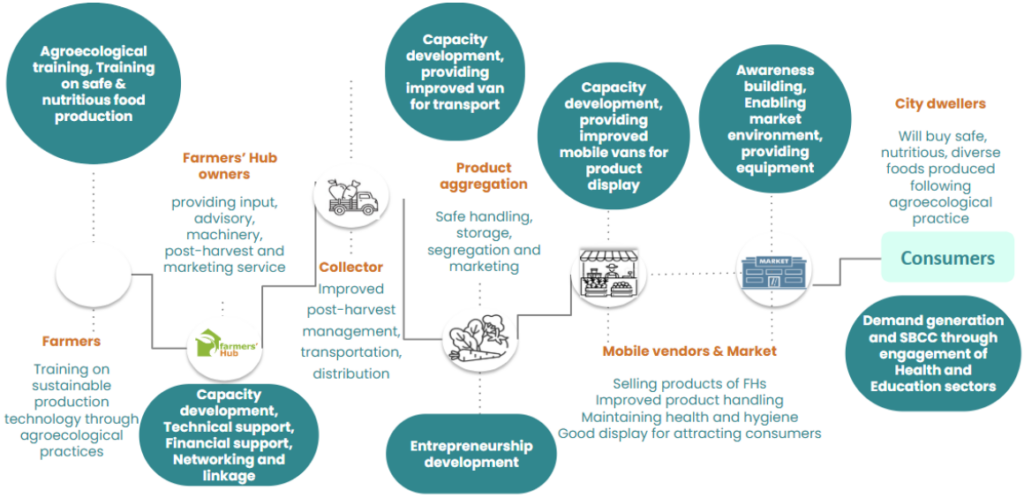
Beyond production, the project connects farmers to urban markets and food environments through improved post-harvest handling, local market linkages, enterprise skills and the promotion of nutritious local foods. These activities strengthen the traceability and movement of agroecologically produced foods from the surrounding city foodshed into urban markets, linking diversified production more directly with healthy diets and consumer demand. Implementation is supported by continuous monitoring of production, income and nutrition outcomes, while the SAF App is used to strengthen farmers’ financial record-keeping and track farm-level economic performance. In this way, the project operationalizes agroecology across the food system from access to productive resources and diversified production to value addition, markets, incomes and consumption.
Results
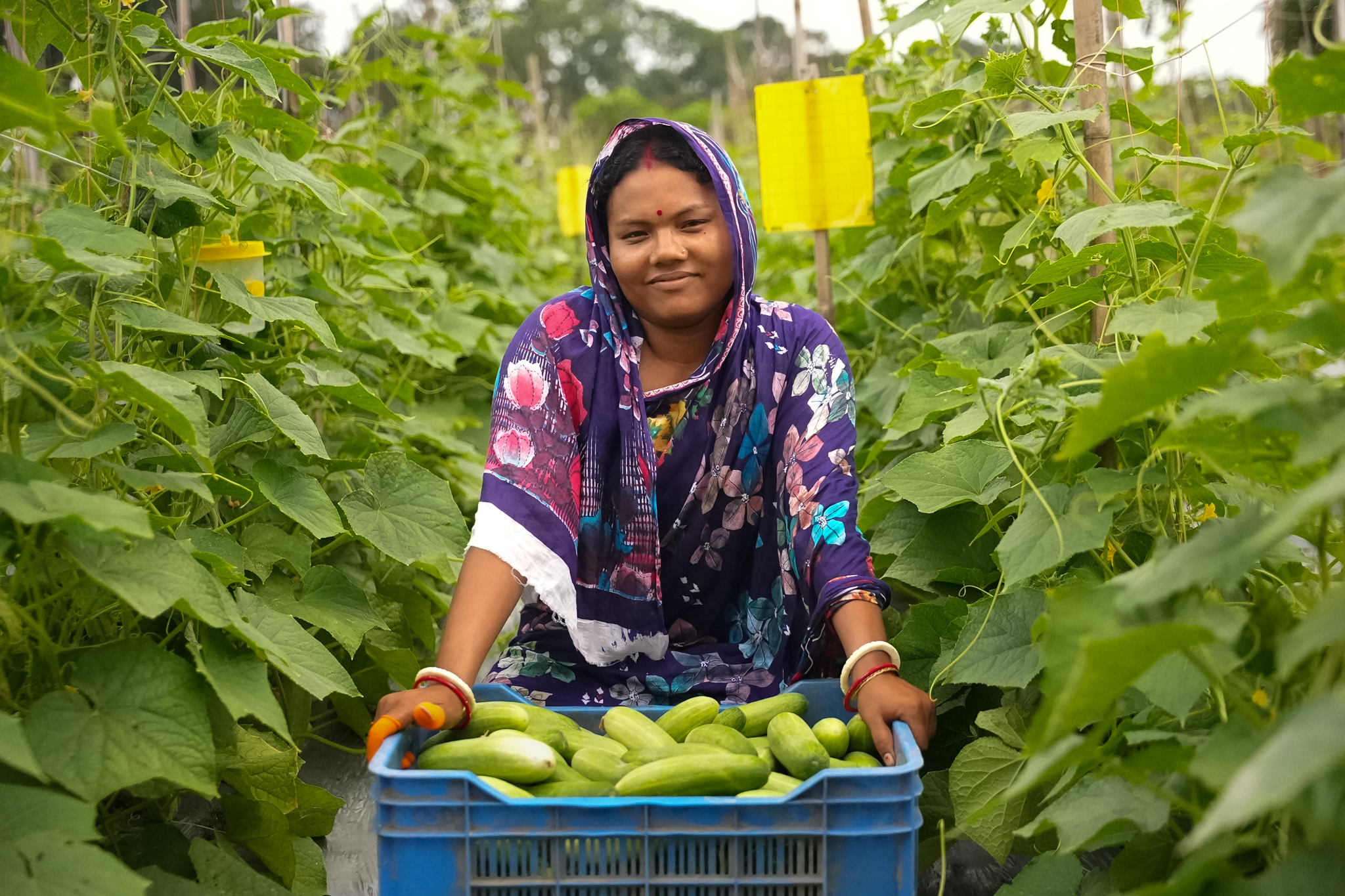
- 100 Farmers’ Hubs established and thriving, with 50 in Dinajpur and 50 in Rangpur, 50 of which are women-led and supporting a total of 32,596 farmers with inputs and services.
- Over 12,604 farmers trained in sustainable agroecology across both cities with over 673 acres of land certified in using agroecological practices and growing nutritious food.
- Over 3000 farmers connected and linked directly to urban markets, reducing waste and post-harvest losses.
- Over 1,135 million tones of safe vegetables delivered to city dwellers generating USD 221,967 in net worth.
- 673 acres of land practicing agroecology, and growing nutritious food.
- Over 32,596 farmers, supported by NICE Farmers’ Hubs, with inputs and services.
Lessons learned
The project demonstrated that secondary cities can provide a strategic entry point for transforming urban food systems. Unlike larger cities where food-system governance can be fragmented across multiple institutions, secondary cities offered a workable scale for bringing together local government, farmers, health workers, food inspectors, teachers, civil society and market actors. Creating these multi-sectoral spaces showed that improvements in nutrition and food systems are more achievable when agriculture, health, education, food safety and markets are addressed collectively, instead of through isolated sectoral interventions.
Another lesson was that promoting agroecological production requires corresponding market opportunities. Training farmers, build their capacities, and supporting the adoption of agroecological practices was more meaningful when producers could connect with food vendors, local suppliers, farmers’ hubs and consumers who could purchase their produce. The project therefore highlighted that agroecological transition cannot focus on production alone. It requires attention to post-harvest handling, market access, enterprise development, food environments and consumer demand to make sustainable production economically viable for farmers.
The project also demonstrated the importance of placing local government at the centre of food-system transformation. Engaging city authorities and embedding nutrition within local mandates, planning processes and budgets strengthened local ownership and provided a pathway for sustaining interventions beyond the project period. At the same time, bringing farmers, health professionals, educators, food inspectors and other stakeholders into shared governance platforms helped establish nutrition and food-system development as a collective local responsibility rather than the mandate of a single institution.
The experience also showed that policy action and market development must reinforce each other. Government policies and institutional commitments can create an enabling environment, but sustainable change also depends on solutions that work under actual market conditions. Partnerships with food vendors, farmers, local suppliers and farmers’ hubs helped identify commercially viable approaches that complemented public interventions. The project consequently demonstrated that lasting food-system transformation emerges from the interaction of effective local governance, functioning markets, agroecological production, cross-sectoral collaboration and sustained demand for safe and nutritious foods.
Limiting barriers
In Bangladesh, the project operates within a food system increasingly constrained by climate shocks and seasonal variability, which affect the reliability of agricultural production and the consistent supply of locally produced foods to urban markets. These pressures are compounded by limited access to finance among smallholder farmers, restricting their ability to invest in agroecological production, inputs, post-harvest activities and local enterprises. Market constraints and price volatility further affect farmers’ incentives to adopt and sustain agroecological practices, particularly where reliable buyers and differentiated markets for agroecologically produced foods remain limited.
Another important constraint is the capacity gap among local food-system actors. Many agricultural professionals, including agronomists and extension actors, have been trained predominantly within conventional and industrial agricultural approaches, resulting in limited practical knowledge and experience with agroecological principles and practices. This creates challenges for providing appropriate technical support to farmers and for mainstreaming agroecology within existing agricultural institutions.
Looking ahead
Sustainable business model
Quotes of participants
I no longer see soil, vegetables, and family health as separate things. By caring for my soil and producing vegetables without synthetic chemicals, I am feeding my children better—and my neighbors are now asking for the same vegetables.
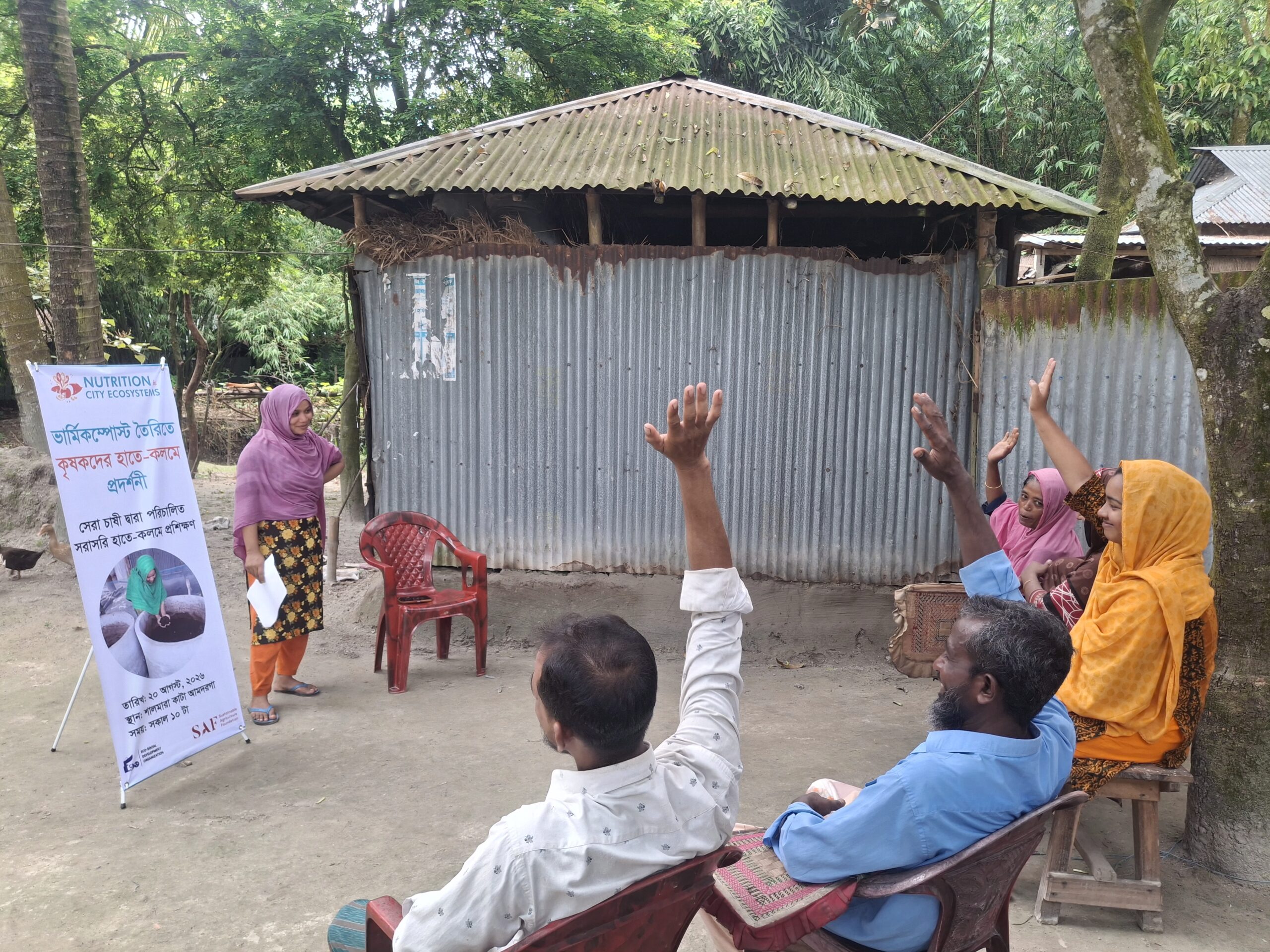
Sharing how to turn organic waste into gold for our soil during the cohort session showed me the true power of community learning. Explaining the long-term benefits of vermicompost wasn’t just about farming technique; it was about showing that women can master agroecological practices, lead technical discussions, and earn respect as agricultural champions in our village.
Hyperlinks
Contact
Md Moshfequel Alam Talukder,
Project Manager, NICE Project, Sustainable Agriculture Foundation, Bangladesh:
Pictures credits: Swiss Tropical and Public Health Institute (Swiss TPH)