Reducing Fungicide Use: Positive Results on A Pilot Banana Plantation
Colombia
The CIRAD Pilot Farm in Colombia tests how pesticide use in export banana production can be substantially reduced while maintaining production and fruit quality. The pilot moves away from systematic fungicide applications towards treatments based on field and biological monitoring, supported by risk assessment, technical assistance, training, and continuous measurement of phytosanitary, agronomic, and economic indicators. This approach brings together research, producers, and value-chain actors to test changes under commercial production conditions and assess their feasibility for wider adoption. The pilot covers a 92-hectare farm, studying it against an 85-hectare control farm. After two years, it achieved a 58–63% reduction in the Treatment Frequency Index (IFT) and a 75% reduction in the quantity of active ingredients used. Mancozeb was eliminated, no active ingredients prohibited in the European Union were used, and no negative impact on yield or fruit quality was recorded. These results provide a practical basis for reducing pesticide dependence in export banana production while considering productivity, production costs, and risks faced by producers.
Lead organizations
Organizations involved in the project include: CIRAD, Tecbaco (a Colombian banana producer and exporter that operates commercial banana plantations in the Magdalena region), LiDL and AZFR.
Other organizations involved in the wider transition approach also work through multi-stakeholder platforms, including the French Initiative for Sustainable Bananas (IFBD) and the World Banana Forum, to connect production-level changes with actors and initiatives across the banana sector.
Country
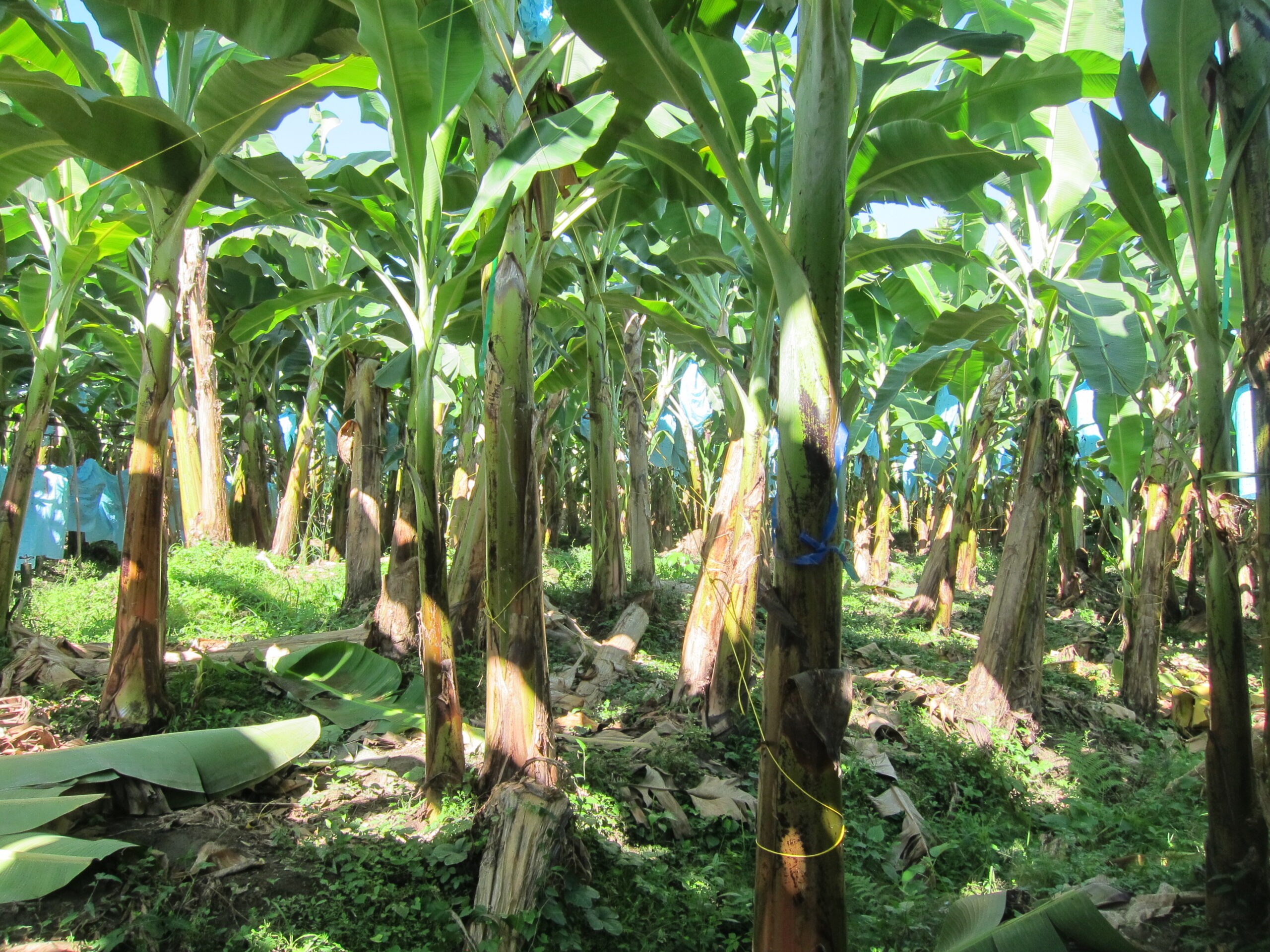
The project is implemented in Zona Bananera Municipality, Magdalena Department, in northern Colombia, through a 92-hectare pilot banana farm, with an 85-hectare farm used as the control.
Timeline
The project started in 2023 and is still ongoing. The pilot implementation phase started in 2024, was extended for a second year and is continuing in 2026.
Funding
The project had a total budget of EUR 288,167 funded by LIDL France, AZ France, CIRAD, and C.I. Técnicas Baltime de Colombia S.A (Tecbaco).
Context
Colombia’s export banana sector operates within a high-input production system where phytosanitary management remains heavily dependent on pesticides, especially fungicides used to control crop diseases. This reflects a wider challenge across the export banana industry, which covers approximately 500,000 hectares worldwide and uses around 30,000 metric tons of pesticide active ingredients annually. The scale and intensity of pesticide use create environmental and production risks and increase the need for production systems that are better adapted to local ecological and phytosanitary conditions. The sector is also responding to changes in export markets and pesticide regulations, including restrictions on active ingredients permitted in the European Union. Reducing the use of the most toxic and ecotoxic products while meeting production and market requirements has therefore become an important transition challenge. This involves more than withdrawing individual pesticides; changes must account for disease pressure, existing fungicide resistance, production costs, labor requirements, potential losses, yield, and fruit quality. In this context, the pilot farm was established to test a shift from systematic fungicide applications to treatments based on field and biological monitoring. Its design integrates phytosanitary, agronomic and economic assessments so that pesticide reduction can be evaluated against both environmental objectives and the practical conditions faced by commercial banana producers.
Main beneficiaries
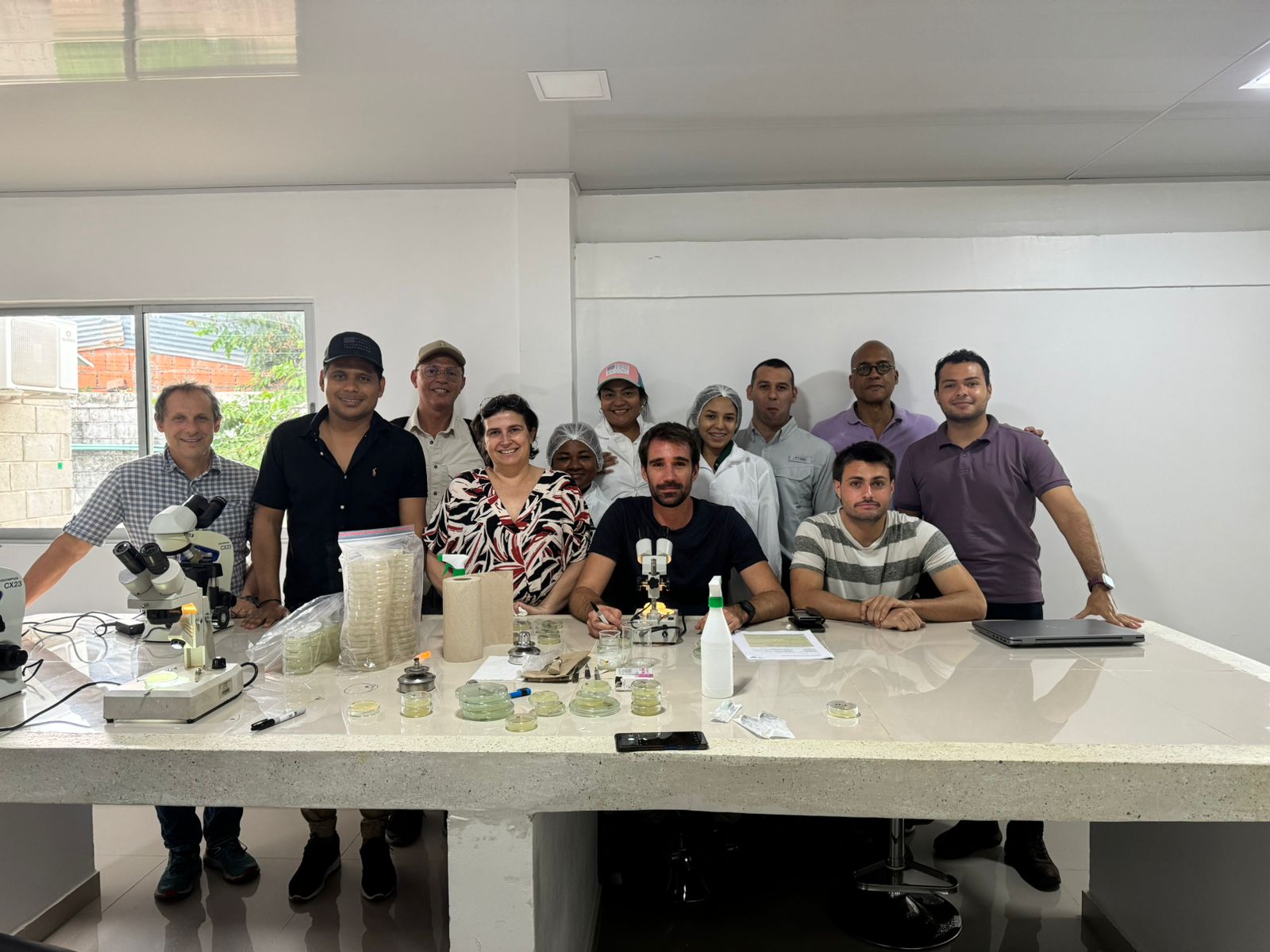
The project primarily benefits commercial banana producers and plantation workers in Colombia’s export banana sector, who benefit from technical support to reduce pesticide use while maintaining production and fruit quality. The pilot also supports farm managers and technical teams through training, biological monitoring, fungicide-resistance monitoring, and the use of agronomic, phytosanitary, and economic indicators to guide treatment decisions.
Strategy
Objectives
The overall objective is to substantially reduce pesticide use in export banana production while maintaining yield, fruit quality, and the economic viability of production. The pilot seeks to move from systematic fungicide applications towards a rational treatment strategy based on field monitoring, while eliminating active ingredients prohibited for use in the European Union.
Specific Objectives include:
- Reducing the Treatment Frequency Index (IFT) by at least 50%.
- Eliminating active ingredients prohibited for use in the European Union.
- Replacing systematic fungicide applications with treatments guided by biological and field monitoring.
- Monitoring disease pressure and existing fungicide resistance to inform treatment decisions.
- Maintaining banana yield and fruit quality during pesticide reduction.
- Assessing the economic implications of the transition, including treatment costs, labor, potential production losses and associated risks.
- Generating evidence and practical experience to support wider transition within the banana sector.
Activities
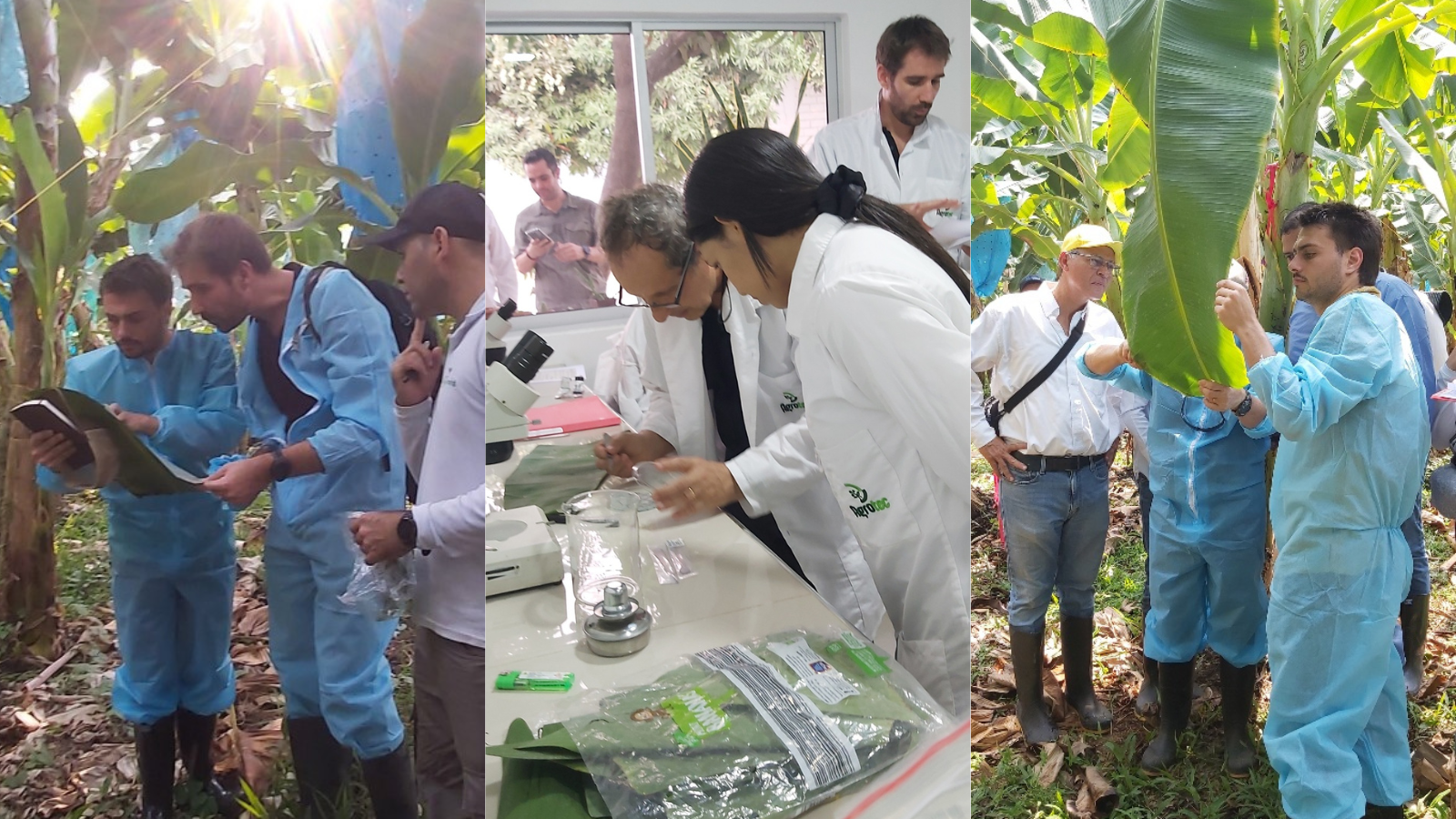
The pilot works with banana producers to replace the systematic spraying of fungicides with treatments based on actual disease pressure and field monitoring. Farm teams undertake the biological monitoring of plantations, assess fungicide resistance, and use this information to determine when treatment is required. CIRAD provides technical support and training to accompany producers and farm teams through the transition.
The project works to reduce pesticide applications and remove active ingredients prohibited in the European Union, while maintaining banana production levels and fruit quality. A 92-hectare pilot farm and an 85-hectare control farm are managed in parallel to test the changes under commercial production conditions and compare their performance.
CIRAD and its partners identify risks and possible intervention points, co-design changes with local actors, and provide technical and organizational support during implementation. The project tracks pesticide use, disease pressure, yield, fruit quality, shelf life, labor, and treatment costs so that changes in pesticide management can be assessed against both farm performance and economic conditions.
At the value-chain level, the work brings together producers, researchers, distributors and other sector actors to coordinate pesticide reduction and identify conditions for wider adoption. Multi-stakeholder platforms such as the French Initiative for Sustainable Bananas (IFBD) and the World Banana Forum are leveraged to connect farm-level changes with wider banana-sector requirements and transition efforts.
Results
- The pilot achieved pesticide reductions beyond its initial 50% IFT reduction target. After two years, the Treatment Frequency Index (IFT) decreased by 58–63%, while the quantity of active ingredients (QSA) fell by 75%.
- The pilot also achieved the complete elimination of Mancozeb, and no active ingredients prohibited for use in the European Union were applied. These reductions were achieved with no negative impact on banana yield or fruit quality, showing that pesticide use can be substantially reduced under the tested commercial production conditions without reducing productive performance.
- The results also established a practical system for moving away from routine fungicide applications towards treatment decisions based on biological monitoring and disease pressure. The comparison between the 92-hectare pilot farm and 85-hectare control farm allowed changes in pesticide use to be assessed alongside fruit quality, shelf life, production, phytosanitary conditions, labor and treatment costs.
Lessons learned
The pilot showed that substantial pesticide reduction is possible without reducing yield or fruit quality when treatments are based on field conditions rather than applied systematically. Ultimately, biological monitoring, assessment of disease pressure and fungicide resistance, and continued technical support reduced pesticide use while maintaining commercial production.
Another lesson is that local partners need continued technical and organizational support throughout the agroecological transition. CIRAD’s approach combines risk diagnosis, identification of possible actions, co-design with stakeholders, technical support and assessment of the conditions required for scaling.
The experience also highlighted the need for a holistic approach to transition. Decisions on pesticide reduction must consider phytosanitary risks alongside production, fruit quality, labor, costs, and potential losses. Monitoring these dimensions helps determine whether proposed changes are technically and economically workable for producers.
The project identified shared responsibility across the value chain as important for sustaining transition. Producers cannot carry the costs, risks, and uncertainty of change alone. Transition efforts need recognition, appropriate support, and participation from other value-chain actors. The project also identifies clear indicators, consideration of costs and value, and reducing uncertainty for producers as necessary conditions for wider change.
Limiting barriers
Transition is constrained by high disease pressure and continued dependence on fungicides in export banana production. Reducing treatments requires reliable biological monitoring and management of existing fungicide resistance, as poorly managed reductions could expose producers to crop losses. Costs and production risks also influence farmers’ willingness and ability to change pesticide practices. Treatment costs, labor, defoliation, potential losses, yield and fruit quality all must be considered when introducing alternatives. In short, the uncertainty associated with changing established production practices remains an important barrier to wider adoption.
The sector is also influenced by export-market requirements and differences in regulations between producing and importing countries. Reducing highly toxic and ecotoxic inputs therefore requires action across the value chain, not only at farm level. Producers need technical support, clear indicators, viable transition costs and appropriate incentives, while buyers, distributors and public authorities need to share responsibility for the transition. Without this support, producers may bear much of the cost, risk and uncertainty associated with changing established production practices, limiting wider adoption and scale-up.
Looking ahead
This project’s priority is to take the experience beyond the pilot farm and support wider change in the export banana sector. The pilot provides a basis for determining which pesticide-reduction practices are ready for wider application and how they can be adapted to different production contexts. Moving to scale will require agreement on a level and pace matching the project’s ambitions, supported by indicators that can track progress and guide decisions. The project also points towards moving from individual farm-level benefits to wider public and sectoral benefits, with stronger involvement of authorities in both producing and importing countries. The longer-term aim is therefore to use evidence from the Colombia pilot to inform broader pesticide-reduction strategies and coordinated action across export banana supply chains, rather than treating the pilot as a stand-alone farm intervention.
Quotes of participants
Above all, we wanted to see if it was possible to implement agronomic practices using fewer pesticides under real-world conditions. And ultimately, the results are quite encouraging: we significantly reduced the number of treatments without any impact on yield or quality. Now, the challenge is to figure out how we can replicate this elsewhere.
Hyperlinks
Contact
Annaïg Blouin – CIRAD – GECO Research Unit (Management of Cultivated Ecosystems), Annaig.blouin@cirad.fr
Pictures credits: CIRAD
Main principles and elements featured in this case: efficiency, resilience, synergies, co-creation and sharing of knowledge, responsible governance, participation, input reduction