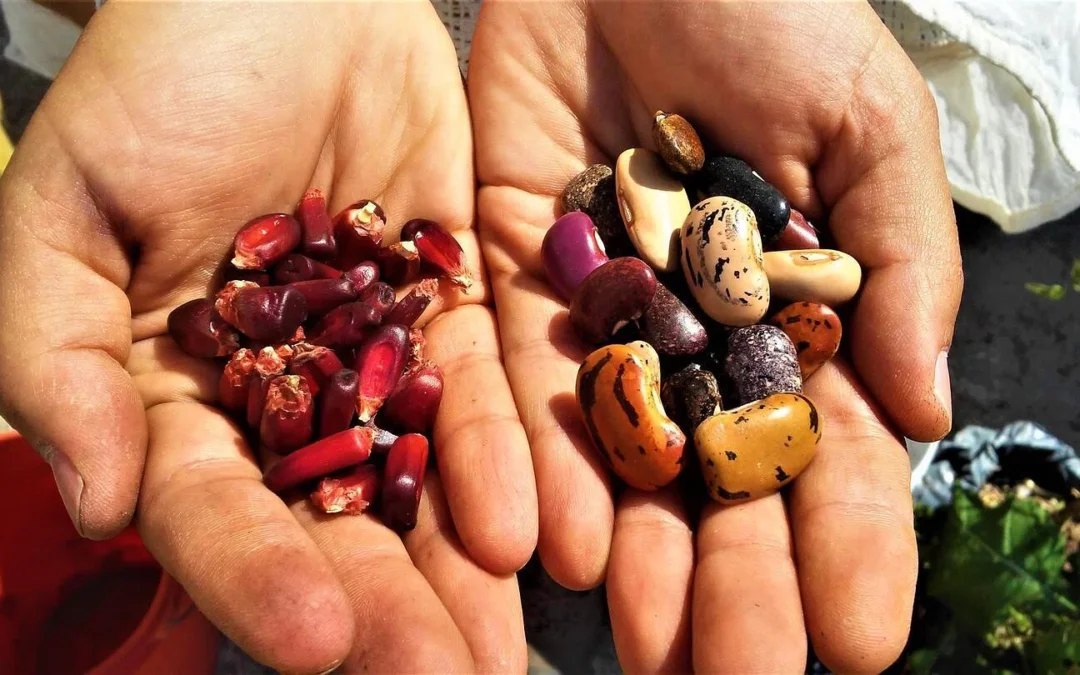
Picture © Mu̱’ta Biocultural, Mexico
Seeds are more than just the starting point of agriculture – they are repositories of culture, knowledge, and resilience passed down through generations. Yet farmer-managed seed systems, which provide an estimated 80 percent of seeds globally, face mounting pressures from restrictive regulations and policies favoring certified commercial seeds. We spoke with our members, CAFOD (Ruth Segal) and SWISSAID (Simon Degelo) about the relationship between seed sovereignty and agroecology. Below you can also find out more about some of the Agroecology Coalition members who are engaged in seed sovereignty.
Why seeds are central to agroecology
“There is no agriculture without seeds,” Simon begins, but the connection goes deeper. The type of seed profoundly influences what farmers can do in their cropping systems. Hybrid maize bred with heavy use of fertilizer and pesticides loses its capacity to resist pests and diseases, while seeds developed under low-input farming conditions maintain valuable traits often lost through industrial breeding.
The third connection is systemic. Applying agroecological principles to seeds means recognizing that traditionally, there’s co-creation of knowledge around seeds, and many societies consider seeds as a good that belongs to everybody. Rather than being owned privately and traded as commodities, seeds circulate within communities through exchange networks, shared learning, and collective stewardship.
Women as seed custodians
Ruth visited CAFOD’s partner in Bangladesh, UBINIG, which works with women seed savers. “The seed savers don’t call it a seed bank, they call it a seed wealth center,” she explains. Each woman saves 8 to 10 varieties at home, then women in each village bring seeds together. At the seed wealth center, Ruth saw 1,800 varieties of rice laid out for drying as well as 200 varieties of mango tree being grown for sharing.
Most remarkably, “the UBINIG researchers knew what all the seeds were and what they all did.” Someone with salinity issues, high elevation, and wind exposure would be matched with the perfect rice variety. “It belongs to everybody. It doesn’t belong to anyone, but it’s in everybody’s hands, available to everyone.”
Seeds, nutrition, and cultural identity
Women seed savers choose seeds based on cooking quality, storage, and nutrition. Indigenous seeds are generally more nutritious and suitable for traditional dishes. Ruth describes a particular sweet biscuit made from specific rice flour, connected to a local festival. “The relationship between seeds, food and culture – they’re so intertwined. When people lose varieties, they also lose an element of their culture.” CAFOD’s research with BIBA-Kenya found that when seed varieties decrease, nutritional diversity decreases, leading to increased health problems and loss of dietary diversity.
Beyond nutrition and culture, seed saving creates vital social connections. In Bolivia, when women regained their role as seed savers, they gained status in the community, participated in meetings differently, and increased their confidence. Women in Kenya lamented: “Seed exchange and sharing provided a ground for socialization. Prohibiting these practices has created a social gap that previously did not exist.”
The impact of restrictive seed laws – and the fight back
BIBA-Kenya examined Kenya’s 2012 Seeds and Plant Varieties Act, which required seed certification and imposed penalties of up to one million Kenyan shillings or two years imprisonment. The certification process cost around 300,000 Kenyan shillings – far beyond most smallholder farmers’ means. More fundamentally, it wasn’t designed for indigenous seeds, requiring varieties to be distinct, uniform and stable, when heterogeneity is precisely what makes farmers’ varieties resilient.
All research respondents reported increased seed costs. Commercial seeds cost approximately four times more than farmer-managed seeds, with limited variety. For indigenous seeds, fear of the law reduced supply, driving up prices.
Women reported harassment by officials and marketing restrictions. Most significantly, fear created a “chilling effect.” “The high penalties and jail term makes most of us indigenous farmers afraid to practice seed saving,” one participant shared. Women could no longer sell seeds but had to sell them as grain at much lower prices. “We are unable to afford basic household amenities because of reduced income.” Notably, no one knew of anyone actually arrested – yet fear alone fundamentally changed behavior.
Because of these negative impacts, a group of smallholder farmers from the Seeds Savers Network, supported by civil society groups, challenged the law in court. On November 27, 2025, the High Court of Kenya in Machakos delivered a historic ruling, declaring key provisions of the Seeds and Plant Varieties Act unconstitutional.
The Court found that the law violated farmers’ constitutional rights to life, livelihood, and food. The judge ruled that by criminalizing the saving, use, exchange and sale of farm-saved seeds, the Act infringed on rights protected by Kenya’s Constitution, the FAO Plant Treaty, and UNDROP. Importantly, the Court determined that the Constitution must be read alongside these international frameworks, particularly UNDROP Article 19, which explicitly recognizes the right to seeds.
The government seed certification authority has indicated it may appeal the ruling, though the deadline for appeal has passed. For now, the sections of the law that contradict the constitutional right to food are suspended. This ruling is a major step toward recognition of farmers’ rights and the centrality of farmer-managed seed systems for Kenya’s food system – and sets a powerful precedent for peasants’ rights globally.
“This judgment rightly recognises that seed sharing is not a crime, but a fundamental element of peasants’ identity, resilience and contribution to national food systems. […] “The Kenyan ruling sends a clear and timely message that human rights obligations cannot be subordinated to commercial seed monopolies or narrow interpretations of plant breeders’ rights,” said the Working Group on Peasants and other people working in rural areas.
Rights versus restrictions
The tension between farmers’ rights and intellectual property represents a fundamental conflict. Ruth explains that the International Union for the Protection of New Varieties of Plants (UPOV- find out more about it in the notes) protects plant breeders’ rights but completely undermines farmers’ rights. Meanwhile, the International Treaty on Plant Genetic Resources for Food and Agriculture (ITPGRFA), the United Nations Declaration on the Rights of Peasants and Other People Working in Rural Areas (UNDROP), and the Convention on Biological Diversity all recognize farmers’ rights.
Ruth identifies a deeper challenge: “There’s a fundamental worldview clash about property rights and ownership versus public goods and the common good. The idea that seeds belong to everyone is beyond the understanding of people into intellectual property. You hit a brick wall.”
Toward pluralistic seed systems
Simon emphasizes the solution isn’t eliminating formal seed systems entirely. “There are some advantages and disadvantages.” The problem is how it works now: five big companies dominating everything, selling products not adapted to agroecology.
“It should be up to the farmer to decide whether to buy from the formal system, informal system, something in between, their neighbor, or faraway farmers who started a cooperative. All should be possible, and farmers are smart – they know which seed works for them.”
The goal is for farmers to have a genuine choice. Currently, many countries regulate seeds so strictly that only certified commercial seeds are legal, leaving farmers with no real alternatives. Pluralistic systems would allow farmers to save their own seeds, exchange seeds with neighbors, or sell through formal markets, all while maintaining sovereignty over their knowledge and varieties.
What farmers need
Kenyan farmers called for the government to recognize farmer-managed seed systems and support seed savers in marketing their seeds. They requested interactions with research centers, support for farmer innovation, and training especially for women. They wanted gender-sensitive policies to enhance women’s access to land, credit, and decision-making.
Simon acknowledges farmer-managed seed systems aren’t perfect: “As knowledge is getting lost, farmer-managed seeds sometimes don’t have the quality they should.” But with proper support – teaching farmers better selection rather than telling them to buy industrial seeds – production could increase significantly. “For 10,000 years, it was farmers doing it. For the last 50 years, the industry has started doing it.”
Seeds of hope
Despite challenges, inspiring initiatives demonstrate possibilities. CAFOD’s partner in Bolivia is using UNDROP to protect indigenous seeds. Partners across Bangladesh, Myanmar and Cambodia exchange knowledge on seeds and agroecological approaches. In Sri Lanka, one CAFOD partner conducts research on indigenous varieties with biofertilizers to counter claims about agroecology’s yields.
Asked what one thing they’d change with a wave of a magic wand, Ruth doesn’t hesitate: “I’d get rid of UPOV. It doesn’t recognize farmers as seed producers, breeders and holders. It’s completely extractive and doesn’t protect their millennia of invention and innovation.” There’s a day of action against UPOV on December 2nd, and “we just need to make more noise.”
Simon agrees UPOV is problematic but notes seed laws regulating what seed can be sold are equally problematic. His magic wand? “I would change the mindset that only formal seeds are good seeds and farmer seeds are bad seeds. If this insight catches on amongst researchers, policy makers and regulators, it would be easy to change seed laws and plant variety protection.”
Sisters, keep seeds in your own hands
This Bangladeshi farmers’ slogan captures a profound truth Ruth observed: seeds belong to everybody and don’t belong to anyone, but are in everybody’s hands, available to everyone.
Seed sovereignty – farmers’ control over seeds and knowledge – is inseparable from food sovereignty, cultural identity, nutrition security, and climate resilience. Without it, the transition to agroecology remains impossible. The path forward requires defending farmers’ rights, supporting farmer-managed systems, recognizing women’s role as seed guardians, and fundamentally shifting how we think about seeds – not as industrial inputs to control, but as living common heritage to share, adapt, and pass to future generations.
Agroecology Coalition members championing seed sovereignty
Several Agroecology Coalition members have made seeds central to their work, recognizing that without farmer control over this fundamental resource, agroecological transformation remains impossible.
SWISSAID: Documenting global seed struggles
SWISSAID’s 2025 report “Seeds at Risk: Global Struggles for Control over Food” provides comprehensive analysis of how corporate concentration, intellectual property regimes, and restrictive seed laws undermine farmers’ rights across continents. The report maps seed regulations in over 120 countries, revealing that in many African nations, seed laws violate farmers’ rights despite farmers being the primary seed producers.
SWISSAID also co-leads CROPS4HD (Collaborative Research on Pluralistic Seed Systems for Diversified Diets), a four-year initiative supporting farmer-managed seed systems in Ecuador, Nepal, South Africa, and Uganda. The project strengthens community seed banks, documents traditional varieties, and advocates for policy reforms recognizing farmers as legitimate seed producers – demonstrating that pluralistic seed systems are both feasible and essential for food security.
CAFOD: Connecting seeds, gender, and rights
CAFOD’s 2024 report “Seed Systems and Gender Equality” documents how restrictive seed laws disproportionately harm women farmers, who in many contexts do the work of saving, preserving, exchanging, and selling seeds while lacking control over land and finances.
CAFOD’s 2023 report “Sowing the Seeds of Poverty” examines how the World Bank has used conditions on development policy lending to promote commercial seed markets and chemical inputs in Africa. The research shows this approach has not effectively reduced poverty or increased food security, and calls for a shift toward supporting agroecological approaches and farmer-managed seed systems.
CAFOD supports partners in Bangladesh, Bolivia, Kenya, Sri Lanka, and other countries to strengthen farmer-managed seed systems and use international frameworks like UNDROP to protect farmers’ rights nationally, demonstrating that seed sovereignty is inseparable from women’s empowerment.
Save Our Seeds: Campaigning against seed privatization
Save Our Seeds, based in Germany, focuses on preventing seed privatization through patents and restrictive plant variety protection laws. The organization has raised awareness about how patents on conventionally bred plants – not just GMOs – threaten access to genetic diversity for plant breeding.
Seeds for All: Building global seed sovereignty networks
Seeds for All is a USA-based organization working globally, which connects grassroots seed sovereignty movements with policy advocacy and capacity building. The organization supports farmer-led seed systems by facilitating knowledge exchange between communities, documenting seed-saving practices, and advocating for policies that protect farmers’ rights to save, share, and sell seeds.
Community Seed Bank Association Nepal: Farmer-led conservation
The Community Seed Bank Association Nepal (CSBAN) coordinates a national network of community seed banks, providing a model of farmer-led biodiversity conservation. The association brings together community seed banks across Nepal to strengthen seed sovereignty through knowledge sharing, capacity building, and collective advocacy. By connecting local seed banks into a national network, CSBAN amplifies farmers’ voices in policy discussions and ensures traditional varieties remain accessible to farming communities.
IFOAM Organics International: Advocating for seed diversity in organic systems
IFOAM Organics International operates a dedicated seed platform that addresses the critical challenge facing organic farmers: the lack of seed varieties bred specifically for organic and low-input farming systems. Most commercially available seeds, even when certified organic, have been bred under conventional high-input conditions and don’t perform optimally in organic systems.
The platform brings together organic farmers, breeders, and researchers to advocate for seed regulations that recognize the needs of organic agriculture. A key focus is supporting the development and legal recognition of heterogeneous plant materials – diverse seed populations that don’t meet industrial standards for uniformity but offer the genetic diversity and adaptability essential for resilient organic farming. The platform also works on ensuring organic farmers maintain the right to save, exchange, and sell seeds, opposing intellectual property restrictions that would undermine these practices fundamental to organic agriculture.
Notes:
|
What is UPOV? The International Union for the Protection of New Varieties of Plants (UPOV) is an international agreement that protects commercial plant breeders’ rights. To qualify for protection under the 1991 UPOV Act, a variety must be distinct, uniform and stable – in other words, genetically homogenous plants that don’t change over generations. This automatically excludes farmers’ seeds, which are heterogeneous and adaptive by nature. UPOV 91t prohibits farmers from exchanging or selling farm-saved seeds from protected varieties and even restricts the use on their own farm. In most cases saving seeds is only permitted for certain crops and only when licence fees are paid to the breeder. This leads to the criminalisation of the traditional practice of farmers’ communities to save, use, exchange and sell farm-saved seeds and violates their rights as granted by the International Treaty for Plant Genetic Resources for Food and Agriculture as well as the UN Declaration on the Rights of Peasants and Other People Working in Rural Areas – practices that have sustained agriculture for millennia. Crucially, UPOV does not recognize farmers as breeders and facilitates the appropriation of farmers’ varieties through breeders. Many countries in the Global South face pressure through trade agreements and development loans to adopt UPOV, even though 80-90% of their seeds come from farmer-managed systems rather than commercial breeders. |
Read also the article “Countries advancing seed sovereignty”, see here.